
Hello and welcome back to Oakville Maids! Today, we’re talking about hard water and how to fight back this summer.
We’re in the middle of summer, which means more showers, more sunscreen rinsed down the drain, and more of that cloudy film showing up on your glass shower doors. Have you ever wondered what that is and why it happens more often during summer?
Today, we’re giving you a few tips on how to deal with hard water and fight back this summer so your house looks pristine.
What’s Hard Water and What’s Causing It?
If you’ve ever wiped down your shower doors on a Tuesday and found them cloudy again by Friday, don’t worry! You’re not doing anything wrong. You just live in Oakville.
Hardness in water comes from minerals naturally present in water like dissolved calcium and magnesium.
When they evaporate off a surface, these minerals stay behind. That’s what causes this chalky, white film. If you don’t wipe and clean surfaces often, they will be harder and harder to remove.
Depending on the amount of minerals present, water is classified as hard or soft in different levels. Our water is treated at the Burloak plant, and the level of hardness for Oakville is in the “moderately hard to hard” territory.
It’s not the worst water in the GTA (Kitchener and Waterloo homeowners deal with double that amount), but it’s enough to leave a mark all over the house, especially when you add summer humidity and extra water to the mix.
Fortunately, this is not a health issue, just a cleaning one. So let’s go room by room and see how we can clean them and remove hard water deposits.
The Bathroom
When it comes to hard water, bathrooms are usually where people notice it first. Glass shower doors go cloudy fastest, often within 8 to 10 weeks if nobody’s squeegeeing after use.
Keep in mind they’re a flat, wide surface that’s in direct contact with water, both splashing and evaporating near the surface, and this increases the amount of minerals sticking to it, even if it’s vertical.
Chrome faucets get that dull, spotty look, and showerheads can lose pressure once these mineral deposits start clogging the nozzle holes. You won’t notice it in a week or two, but you will after months or years without cleaning them.
What to do: Squeegee glass and faucets right after every shower. It takes 15 seconds and stops most buildup before it starts. Once a week, spray a 1:1 mix of white vinegar and water on glass and fixtures. Let it sit for 10 minutes, then wipe with a microfiber cloth.
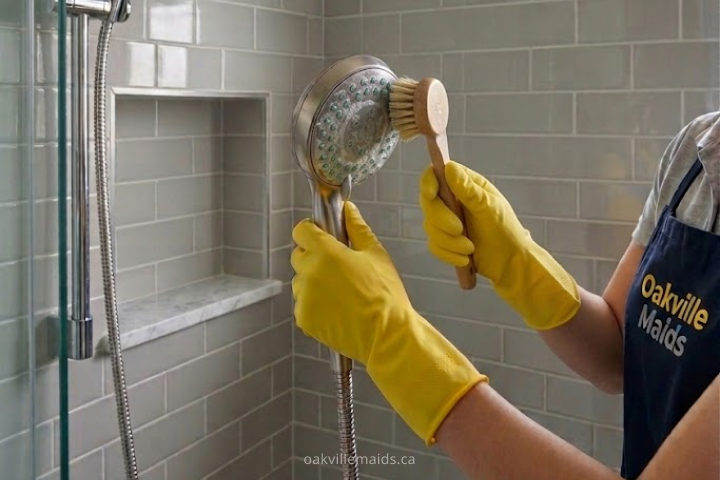
For a clogged showerhead, fill a sandwich bag with straight white vinegar, secure it around the head with a rubber band, and let it soak for at least an hour. Scrub gently with an old toothbrush afterward.
Grout is the one area people miss the most. Grout lines are already hard to clean per se, and with hard water, it becomes an even bigger challenge.
Hard water residue mixes with soap scum into a paste that’s stickier than either one alone, and it grabs onto grout lines fast. You can counterattack with the same vinegar solution. Let sit for a few extra minutes and scrub with a soft bristle brush.
The Kitchen
The main areas affected by hard water in your kitchen area faucets and the sink basin. They can also develop the same dull spotting you’d see in a bathroom, where these minerals stick to after using your faucet.
Besides these areas, kettles are the sleeper problem in the kitchen. If you’ve ever poured a kettle and seen white flakes floating in your tea, that’s limescale breaking off the heating element.
What to do: For a kettle, fill it halfway with equal parts water and white vinegar, bring it to a boil, then let it sit for 20 minutes before rinsing well and running one cycle of plain water. Do this monthly if you use your kettle daily, or if you start noticing visible hard water spots.
You can also do this with a lemon half if you run out of white vinegar. The good thing about lemon is that you can use that same lemon half to softly rub against the bottom of your kettle and then rinse to remove limescale and lemon residue.
For the sink and faucet, the same vinegar spray and wipe routine from the bathroom works fine.
If your dishwasher is leaving cloudy spots on glasses, that’s (most likely) hard water too. To clear this up, refill your dishwasher rinse-aid and add a dishwasher cleaning tablet once or twice a month.
You can also try putting your cloudy glasses on the top rack and a dishwasher-safe bowl with white vinegar on the bottom rack. Run a normal cycle without any detergent.
If the issue persists, try changing your dishwasher detergent brand.
The Laundry Room
Hard water makes detergent less effective, since the minerals “blend” with soap before it can fully lather and rinse away. Besides reducing the effectiveness of your detergent, these minerals will start “clinging” to fabrics as well.
This won’t have much of an impact right away but, over time, it will leave towels feeling stiff and colors looking dull, even when everything technically got washed. Remember this is not a health or hygiene issue, so your clothes and linens are still technically clean.
What to do: Add a scoop of washing soda to your regular detergent load. It softens the water just enough to help detergent do its job properly.
If towels already feel stiff, run them through a wash with a cup of white vinegar in the rinse cycle instead of fabric softener. This removes mineral buildup and leaves fabric noticeably softer.
Replacing fabric softener with vinegar is helpful in many other ways as well: it’s cheaper, less harmful to the environment, and you won’t notice a waxy coating on your towels anymore.
If this trick helps you with your towels and fabrics, don’t be afraid to keep doing it for the rest of the year!
Outdoor Spaces
With outdoor spaces, it’s common to see limescale deposits on patios, outdoor faucets, and pool decks, especially if you’re topping up a pool or filling planters from a hose all summer.
With hard water, minerals evaporate on stone and concrete just like they do on glass (e.g. your shower walls), leaving a chalky residue behind.
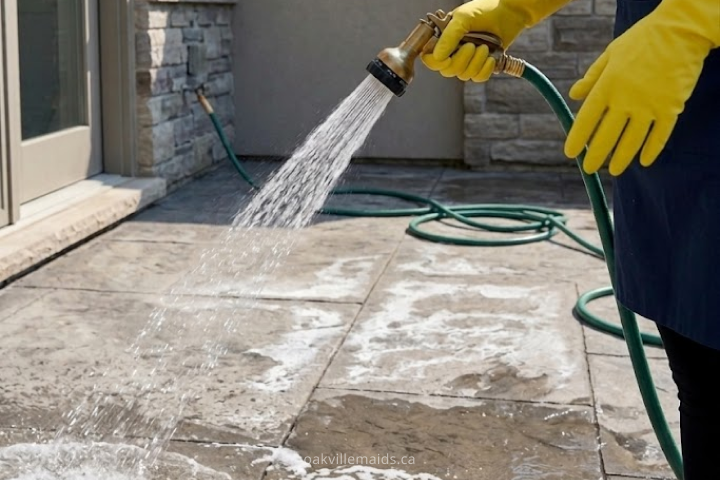
What to do: Hose down your patio stone regularly so water doesn’t sit and evaporate in one spot. For visible white buildup on stone or concrete, a mix of dish soap and water with a stiff outdoor brush handles most of it. With these stiff outdoor brushes, always try first in a small area so you can find the right technique to avoid scratching your floors or walls.
Save vinegar for smaller fixtures like outdoor taps, since it can be too acidic for certain natural stone.
When It’s Time to Consider a Softener
If scale is showing up inside appliances (kettles, dishwashers, coffee makers) and not just on visible surfaces, that’s usually a sign the mineral load is heavier than surface cleaning alone can manage.
Water heaters are the biggest concern here. Scale buildup inside a tank acts like insulation, so the unit has to work harder and use more energy to heat the same amount of water.
Whole-home softeners are not cheap. They cost a few thousand dollars to get installed, but they can meaningfully extend appliance lifespan if you’re planning to stay put for a while. Think of it as a long-term investment only.
For most Oakville households, though, a consistent weekly routine across these few spots handles the bulk of the problem. The water isn’t going to change. What changes is how much time you spend cleaning up after it.
If you’d rather skip the weekly vinegar sprays and want your surfaces sparkling fast, consider booking a deep cleaning service to tackle the buildup all at once. Removing limescale deposits is one of our most common requests from our clients, and it’s a solid option for getting ahead of the hard water cycle during the summer.
Conclusion
That’s it. Hard water shows up everywhere from your showerhead to your kettle to your patio stone, but a squeegee, a bottle of vinegar, and a little consistency go a long way in every room.
If it’s already past the DIY stage, or you’d rather hand off the scrubbing this summer, that’s exactly what we do. Check out Oakville Maids, your local house cleaning service in Oakville, and we’ll get your home looking new again so you don’t have to keep up with hard water on your own.
Feel free to reach out anytime if you’d like a hand, or check out more cleaning tips on our blog. In the meantime, hope this summer treats your home (and your patience) a little better!